


 Español
 Pусский
 한국어
한국어 中文
中文


Rubber Automation Equipment with Mold
Rubber Automation Equipment with Mold: Enhancing Efficiency and Precision in Manufacturing Rubber automation equipment integrated with molds plays a critical role in modern manufacturing, enabling high-speed, precise, and repeatable production of rubber components. These systems are widely used in industries such as automotive, electronics, medical devices, and consumer goods, where consistent quality and efficiency are paramount. Key Components and Functionality 1. Automated Rubber Processing Machines These machines handle tasks like mixing, extrusion, injection molding, and compression molding. Automated systems ensure uniform material distribution, reducing waste and improving product consistency. Advanced models feature real-time monitoring and adjustments to maintain optimal processing conditions. 2. Mold Integration Precision molds are designed to shape rubber into specific forms, ranging from simple gaskets to complex seals or automotive parts. Automated systems ensure accurate mold alignment, temperature control, and ejection, minimizing defects and downtime. Quick-change mold systems further enhance flexibility for multi-product production. 3. Robotics and Material Handling Robotic arms are often integrated to transfer raw materials, load/unload molds, and sort finished products. Vision systems and sensors ensure precise placement, reducing human error and increasing throughput. 4. Quality Control Systems Automated inspection tools, such as laser scanners or cameras, verify dimensional accuracy and detect flaws in real time. Defective parts are automatically rejected, ensuring only high-quality products proceed downstream. Advantages of Automation - Increased Productivity: Continuous operation with minimal manual intervention maximizes output. - Consistency and Precision: Automated controls eliminate variability, ensuring uniform product quality. - Cost Efficiency: Reduced material waste, lower labor costs, and extended mold life contribute to long-term savings. - Safety: Minimizing human interaction with high-temperature or high-pressure processes enhances workplace safety. Applications - Automotive: Seals, gaskets, vibration dampers. - Electronics: Keypads, insulation components. - Medical: Silicone tubing, seals for devices. - Consumer Goods: Footwear, household rubber products. Future Trends Emerging technologies like AI-driven predictive maintenance, IoT-enabled process optimization, and sustainable material processing are shaping the next generation of rubber automation equipment. These advancements will further improve efficiency, reduce energy consumption, and support eco-friendly manufacturing. In conclusion, rubber automation equipment with molds revolutionizes production by combining precision engineering with smart automation, delivering superior performance across diverse industries.
Products
Category:
-
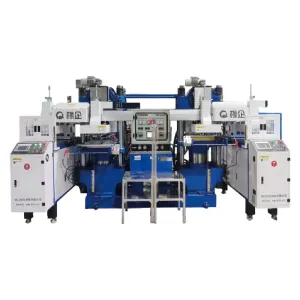
XP (GT200S/GT300S/GT400S) H Cold Feed Dual-unit Rubber Automation Equipment
Category: Rubber EquipmentBrowse number: 49Number:Release time: 2025-12-31 10:50:51Equipment Description:Rubber strip raw material is cold-fed into the feeding port. The process includes conveying and plasticizing, rubber blank loading, product vulcanization, product demolding, finished product boxing, and mold cleaning. When integrated with a vulcanizing press, it forms a closed-loop process flow, enabling fully automated production.Application Scope:1. Rubber materials, including Nitrile (NBR), Hydrogenated Nitrile (HNBR), Fluoroelastomer (FKM), Ethylene Propylene Diene Monomer (EPDM), Natural Rubber (NR), Butyl Rubber (IIR), and Recycled Rubber.2. Suitable products: Rubbe...
News
Category:
-
[FAQ]Optimizing Your Workflow with Advanced Rubber Automation Equ...
2025-12-27 14:14:33
Case
Category:
No search results found!
Video
Category:

Download
Category:
No search results found!
Job
Category:
No search results found!
Featured Products
No search results found!


