

 Español
 Pусский
 한국어
한국어 中文
中文


Fully Automatic Silicone Products Production Line with Extrusion Equipment
Fully Automatic Silicone Products Production Line with Extrusion Equipment A fully automatic silicone products production line integrated with extrusion equipment is a highly efficient and advanced manufacturing system designed to produce high-quality silicone components with minimal human intervention. This production line is widely used in industries such as medical devices, automotive, electronics, and consumer goods, where precision, durability, and consistency are critical. Key Components of the Production Line 1. Silicone Material Preparation System The process begins with the preparation of silicone compounds, which may include base polymers, fillers, and additives. The raw materials are precisely measured and mixed in an automated mixer to ensure uniformity. The mixed silicone is then fed into the extrusion system. 2. Extrusion Equipment The extrusion system is the core of the production line, where the silicone compound is shaped into continuous profiles, tubes, or custom cross-sections. The extruder consists of a screw-driven mechanism that pushes the silicone through a heated barrel, softening it before it passes through a die to form the desired shape. Advanced extrusion systems feature temperature control, pressure monitoring, and real-time adjustments to maintain product consistency. 3. Curing System After extrusion, the silicone profiles enter a curing oven or UV curing system, where they undergo vulcanization to achieve their final mechanical properties. The curing process ensures elasticity, heat resistance, and chemical stability. 4. Cooling and Cutting Units Once cured, the silicone products are cooled using air or water cooling systems to stabilize their dimensions. An automated cutting machine then trims the extruded profiles to the required lengths with high precision. 5. Inspection and Quality Control Vision systems, laser measurement devices, or manual sampling may be integrated to check for defects such as air bubbles, dimensional inaccuracies, or surface imperfections. Non-conforming products are automatically rejected. 6. Packaging and Stacking The final step involves automated packaging, where silicone products are sorted, counted, and packed into boxes or reels. Some systems include robotic arms for palletizing finished goods. Advantages of the Fully Automatic System - High Productivity: Continuous operation reduces downtime and increases output. - Consistency: Automated controls ensure uniform product quality. - Labor Savings: Minimal manual handling reduces labor costs and human error. - Flexibility: Adjustable parameters allow quick changes for different product specifications. - Waste Reduction: Precise material usage and recycling systems minimize scrap. This fully automated silicone extrusion production line is ideal for manufacturers seeking efficiency, scalability, and superior product quality in silicone component production.
Products
Category:
-
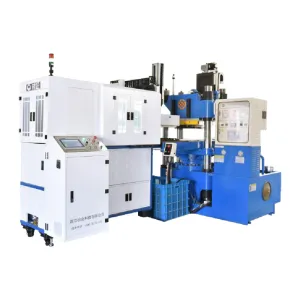
XQ (GT300S) H Cold Feed Front-mounted Standalone Unit Rubber Automation Equipment
Category: Rubber EquipmentBrowse number: 49Number:Release time: 2025-12-31 10:49:28Equipment Description:Rubber strip raw material is cold-fed into the feeding port. The entire process includes conveying and plasticizing, rubber blank loading, product vulcanization, demolding, finished product boxing, and mold cleaning. When integrated with a vulcanizing press, it forms a closed-loop process flow, enabling fully automated production.Application Scope:1. Rubber materials, including Nitrile (NBR), Hydrogenated Nitrile (HNBR), Fluoroelastomer (FKM), Ethylene Propylene Diene Monomer (EPDM), Natural Rubber (NR), Butyl Rubber (IIR), and Recycled Rubber.2. Suitable products: Rubber...
News
Category:
-
[FAQ]Silicone Automation Solutions for the Medical and Food Indus...
2025-12-27 14:06:07
Case
Category:
No search results found!
Video
Category:

Download
Category:
No search results found!
Job
Category:
No search results found!
Featured Products
No search results found!


