
 Español
 Pусский
 한국어
한국어 中文
中文


Fully Automatic Rubber Production Line
Fully Automatic Rubber Production Line A fully automatic rubber production line is an advanced manufacturing system designed to streamline the entire process of rubber product manufacturing, from raw material processing to final product output, with minimal human intervention. This highly efficient and precise system integrates cutting-edge automation technologies, including robotics, computerized control systems, and AI-driven quality inspection, to ensure consistent product quality, high throughput, and reduced operational costs. Key Components and Workflow 1. Raw Material Handling and Mixing The process begins with the automated feeding of raw rubber compounds, fillers, and additives into a precision mixing system. Computer-controlled mixers ensure uniform blending, with real-time monitoring of temperature, pressure, and viscosity to maintain optimal material properties. 2. Extrusion and Molding The mixed rubber is then transferred to extrusion machines or injection molding units, where it is shaped into sheets, profiles, or specific product forms. Advanced servo-driven extruders and molds guarantee high dimensional accuracy, while automated cutting systems trim excess material for recycling. 3. Vulcanization (Curing) The shaped rubber undergoes vulcanization in temperature-controlled curing presses or continuous vulcanization tunnels. Automated systems adjust curing parameters (time, temperature, pressure) based on real-time sensor feedback to enhance product durability and elasticity. 4. Cooling and Finishing Post-curing, products move through cooling chambers to stabilize their structure. Robotic arms then handle secondary processes like deburring, surface treatment, or printing (e.g., logos, barcodes) with laser precision. 5. Quality Inspection and Packaging AI-powered vision systems and mechanical testers inspect each product for defects (e.g., air bubbles, dimensional errors). Approved items are automatically sorted, labeled, and packaged, while rejected units are diverted for reprocessing. Advantages - Efficiency: 24/7 operation with minimal downtime, significantly boosting production capacity. - Consistency: Eliminates human error, ensuring uniform product quality. - Cost-Effectiveness: Reduces labor costs and material waste through optimized processes. - Flexibility: Quick reprogramming allows switching between different rubber formulations and product designs. Applications Fully automatic rubber production lines are widely used in automotive (seals, tires), medical (gloves, tubing), industrial (gaskets, hoses), and consumer goods (footwear, seals) industries. By integrating Industry 4.0 technologies like IoT and predictive maintenance, these systems represent the future of smart, sustainable rubber manufacturing.
Products
Category:
Rubber Equipment
-
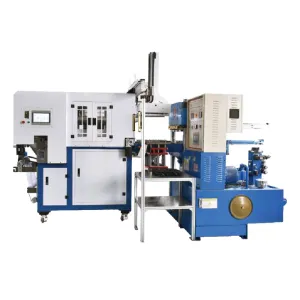
XQ (JS650-2S)/ XQ (JS1100-2S) Specialized Rubber Automation Equipment for Medical Rubber Stoppers
Category: Rubber EquipmentBrowse number: 35Number:Release time: 2025-12-31 10:39:04Equipment Description:1. The equipment is suitable for sheet-fed products, enabling synchronous production with two molds. Each vulcanization cycle produces two mold sets of products, offering simple operation and high production efficiency.2. Rubber sheet or roll raw material undergoes a complete process including conveying and loading, length-based cutting, product vulcanization, demolding, finished product boxing, mold release agent spraying, and mold cleaning. When integrated with a vulcanizing press, this forms a closed-loop process flow, achieving fully automated production.Application S...
News
Category:
-
[FAQ]Choosing Between Rubber and Silicone Automation Equipment
2025-12-27 13:37:38
Case
Category:
No search results found!
Video
Category:

Download
Category:
No search results found!
Job
Category:
No search results found!
Featured Products
No search results found!


